
What Is Fibermaxxing? The Wellness Trend Everyone Is Talking About in 2026
If you have been scrolling through health content recently, you have probably noticed a new word showing up everywhere. Fibermaxxing. It sounds like another social media wellness gimmick. However, unlike many viral health trends that disappear after a few weeks, this one is backed by decades of solid nutritional science.
The best remote jobs you can do from Pakistan in 2026 pay well. However, none of them matter much if your health is suffering. That connection might seem odd, but fibermaxxing is fundamentally about optimising the foundation of your health and it is something anyone can do regardless of budget or location.
Fibermaxxing is the practice of deliberately and consistently maximising your daily dietary fiber intake. Furthermore, it is not a complicated protocol, an expensive supplement stack, or a restrictive elimination diet. It is simply eating significantly more fiber than the average person consumes, with a clear understanding of why it matters and how to do it practically.
This guide explains what fibermaxxing actually is, what the science says about high fiber intake, how to do it practically, and whether it is genuinely worth adopting.
What Is Fibermaxxing Exactly?
The term combines fiber with maxxing a suffix that has become common in wellness communities to describe the practice of optimising a specific health variable to its maximum beneficial level.
Fibermaxxing means deliberately eating as much dietary fiber as possible within healthy ranges typically targeting 35 to 60 grams per day, well above the standard recommendation of 25 to 38 grams for adults. Furthermore, it means prioritising fiber-dense foods at every meal rather than treating fiber as an afterthought.
The trend has been growing steadily rather than spiking suddenly, which typically indicates a durable lifestyle shift rather than a passing fad. Additionally, it aligns with a broader pattern of people taking a more systematic approach to nutrition rather than following generic healthy eating advice. Glimpse
The key distinction between fibermaxxing and simply “eating more vegetables” is intentionality. Fibermaxxers track their fiber intake, understand the difference between soluble and insoluble fiber, and actively structure their meals around fiber density rather than treating it as a side consideration.
Why Fiber Matters More Than Most People Realize
Most people know vaguely that fiber is good for digestion. However, the actual scope of what dietary fiber does in the body goes far beyond preventing constipation. In fact, fiber affects almost every major system in your body in ways that researchers are still discovering.
The Gut Microbiome Connection
This is where modern fiber science gets genuinely fascinating. Your gut contains approximately 100 trillion microorganisms bacteria, fungi, and other microbes collectively known as the gut microbiome. Furthermore, these microorganisms play a central role in your immune function, mental health, inflammation levels, metabolism, and even your risk of chronic diseases.
Dietary fiber is the primary food source for beneficial gut bacteria. When you eat fiber, your gut bacteria ferment it and produce short-chain fatty acids particularly butyrate, propionate, and acetate. These compounds are not waste products. They are active signalling molecules that reduce inflammation, maintain the integrity of your gut lining, regulate appetite hormones, and even communicate with your brain through what researchers call the gut-brain axis.
Consequently, when you eat very little fiber, you are essentially starving the most health-promoting bacteria in your gut. Over time this leads to reduced microbiome diversity a state consistently associated with increased risk of inflammatory conditions, metabolic disease, and even mental health disorders.
Cardiovascular Health
The evidence linking high fiber intake to cardiovascular health is among the most robust in nutritional science. Soluble fiber found in oats, beans, lentils, and fruits forms a gel-like substance in your digestive tract that binds to cholesterol and carries it out of your body before it can be absorbed.
Additionally, high fiber intake is associated with lower blood pressure, reduced inflammation, and better glycemic control all of which contribute to cardiovascular health. Moreover, multiple large-scale studies have found that people who eat the most dietary fiber have significantly lower rates of heart disease than those who eat the least.
Blood Sugar Regulation
Fiber dramatically slows the absorption of sugar into your bloodstream. As a result, meals that are high in fiber produce a much more gradual rise in blood glucose compared to equivalent meals without fiber. This is critically important for people managing diabetes or insulin resistance, but it also matters for everyone in terms of energy levels, hunger management, and long-term metabolic health.
Furthermore, consistent high fiber intake is associated with reduced risk of type 2 diabetes in large population studies. The mechanism is well understood better glycemic control, improved insulin sensitivity, and a healthier gut microbiome that influences glucose metabolism.
Weight Management
Fiber is uniquely satiating. It takes up physical space in your stomach, slows gastric emptying, and triggers satiety hormones that signal to your brain that you are full. Consequently, high-fiber meals keep you satisfied for longer than low-fiber meals of similar caloric content.
Additionally, fiber itself provides minimal calories approximately 2 calories per gram compared to 4 calories per gram for other carbohydrates. This means that eating more fiber-dense foods naturally displaces higher-calorie options without requiring calorie counting or restriction.
Colorectal Health
Higher dietary fiber intake is consistently associated with reduced risk of colorectal cancer in population studies. Furthermore, fiber speeds transit time in the colon meaning potential carcinogens spend less time in contact with the colon wall. The butyrate produced by fiber fermentation also has direct anti-cancer properties in colon cells.
Soluble vs Insoluble Fiber: Why Both Matter
Not all fiber is the same. Understanding the two main types helps you build a more complete fiber strategy.
Soluble Fiber
Soluble fiber dissolves in water and forms a gel in your digestive tract. Furthermore, it is the type most directly linked to cholesterol reduction, blood sugar regulation, and feeding beneficial gut bacteria.
The best sources of soluble fiber include oats and oat bran, beans and lentils, apples and pears, psyllium husk, barley, and flaxseeds. Psyllium husk in particular is exceptionally high in soluble fiber and is commonly used by people actively targeting high fiber intake.
Insoluble Fiber
Insoluble fiber does not dissolve in water. Instead, it adds bulk to stool and speeds transit time through the digestive system. Additionally, it is primarily responsible for the digestive regularity benefits most people associate with fiber.
The best sources of insoluble fiber include whole wheat and wheat bran, vegetables particularly the skins, nuts, and seeds. Furthermore, most plant foods contain both types in varying proportions, which is why eating a wide variety of fiber sources is more effective than focusing on a single food.
How Much Fiber Do You Actually Need?
The standard recommendation for adults is 25 to 38 grams of dietary fiber per day 25 grams for women and 38 grams for men. However, most people eat only 12 to 18 grams per day. This means the average person is eating less than half the recommended amount.
Fibermaxxing targets the upper range and beyond typically 40 to 60 grams per day for adults without medical conditions that contraindicate high fiber intake. Furthermore, some practitioners target higher amounts, though the evidence for benefit beyond 60 grams is less clear than the evidence for benefits in the 35 to 60 gram range.
The important caveat is to increase fiber intake gradually rather than suddenly. Adding large amounts of fiber quickly causes bloating, gas, and digestive discomfort as your gut microbiome adjusts. Consequently, a practical approach is to add 5 grams of fiber per week until you reach your target intake.
The Best High-Fiber Foods to Build Your Diet Around
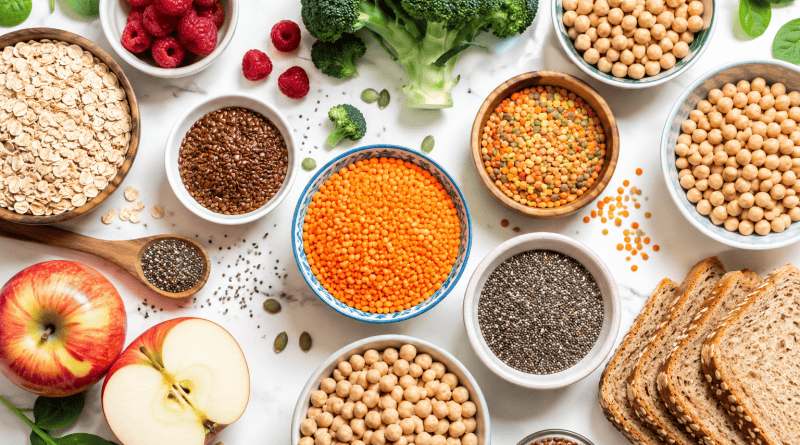
Fibermaxxing works best when you build meals around naturally fiber-dense whole foods rather than relying on supplements or processed high-fiber products.
Legumes The Fiber Champions
Legumes are by far the most fiber-dense foods available. Furthermore, they combine high fiber with high protein, making them nutritionally outstanding.
- Lentils: 15.6g fiber per 100g cooked one of the highest-fiber foods available
- Black beans: 8.7g fiber per 100g cooked excellent for South Asian cooking
- Chickpeas: 7.6g fiber per 100g cooked versatile for curries, salads, and snacks
- Kidney beans: 7.4g fiber per 100g cooked widely available and affordable
- Split peas: 8.3g fiber per 100g cooked excellent for dal and soups
For Pakistani readers, dals are genuinely one of the best fibermaxxing foods in the world. A daily serving of mixed dal covers a substantial portion of your fiber target at minimal cost.
Whole Grains
- Oats: 10.6g fiber per 100g dry particularly high in soluble beta-glucan fiber
- Whole wheat: 12.2g fiber per 100g dramatically higher than refined flour
- Brown rice: 3.5g fiber per 100g cooked significantly more than white rice
- Barley: 6.0g fiber per 100g cooked excellent for soups and as a rice alternative
Switching from white rice and refined flour products to whole grain alternatives is one of the highest-impact simple changes for increasing fiber intake. Furthermore, this change benefits your gut microbiome, blood sugar levels, and cardiovascular health simultaneously.
Vegetables
- Artichokes: 8.6g fiber per 100g one of the highest-fiber vegetables
- Broccoli: 2.6g fiber per 100g excellent in combination with other sources
- Carrots: 2.8g fiber per 100g widely available and affordable
- Spinach: 2.4g fiber per 100g cooked nutrient dense alongside fiber content
- Sweet potato with skin: 3.3g fiber per 100g significantly higher than without skin
Keeping vegetable skins on wherever possible significantly increases fiber content. Additionally, eating a wide variety of vegetables provides diverse types of fiber that feed different beneficial bacterial species.
Fruits
- Raspberries: 6.5g fiber per 100g among the highest-fiber fruits available
- Pears with skin: 3.1g fiber per 100g soluble fiber particularly high
- Apples with skin: 2.4g fiber per 100g the skin contains most of the fiber
- Bananas: 2.6g fiber per 100g also a good prebiotic food
- Guava: 5.4g fiber per 100g particularly accessible and affordable in Pakistan
Seeds and Nuts
- Chia seeds: 34.4g fiber per 100g extraordinarily high concentration
- Flaxseeds: 27.3g fiber per 100g excellent for adding to smoothies or yogurt
- Almonds: 12.5g fiber per 100g healthy fat and fiber combination
- Psyllium husk: approximately 70g fiber per 100g the most concentrated fiber source available
Chia seeds and psyllium husk are the two most popular fibermaxxing supplements because they add fiber with minimal taste or preparation required.
A Practical Day of Fibermaxxing
Understanding the theory is one thing. Here is what a high-fiber day actually looks like in practice targeted at approximately 50 grams of fiber.
Breakfast approximately 15g fiber
Overnight oats made with 80g rolled oats (8g fiber), topped with 2 tablespoons of chia seeds (7g fiber), sliced banana (2.6g fiber per 100g), and a handful of raspberries (6.5g fiber per 100g). This breakfast alone covers nearly a third of the daily target while being genuinely delicious.
Lunch approximately 18g fiber
A large bowl of mixed dal (200g cooked lentils and chickpeas approximately 14g fiber) served with whole wheat roti (3g fiber each) and a side salad with raw vegetables (3 to 4g fiber).
Snack approximately 5g fiber
An apple eaten with skin (2.4g fiber) and a small handful of almonds (3g fiber per 30g serving).
Dinner approximately 12g fiber
A mixed vegetable curry with kidney beans (7g fiber per 200g cooked) served over brown rice (3.5g fiber per 150g cooked) with a side of cooked spinach (2g fiber).
Total: approximately 50g fiber achieved entirely through whole foods without any supplements.
Common Fibermaxxing Mistakes to Avoid
Increasing intake too quickly. This is the most common mistake and the one that gives fibermaxxing an unfair reputation for causing digestive discomfort. Increase gradually over four to six weeks. Consequently, your gut microbiome has time to adapt without producing excessive gas or bloating.
Not drinking enough water. Fiber absorbs water in your digestive tract. Without adequate hydration, high fiber intake can actually worsen constipation rather than relieve it. Furthermore, aim for at least 2.5 to 3 liters of water per day when fibermaxxing.
Relying too heavily on supplements. Psyllium husk and chia seeds are useful tools but they do not provide the full spectrum of compounds found in whole plant foods. Additionally, the diversity of fiber sources matters different types of fiber feed different bacterial species and produce different health benefits.
Ignoring digestive signals. Some people have conditions irritable bowel syndrome, inflammatory bowel disease, or specific food intolerances that require modified fiber approaches. Furthermore, if you experience persistent digestive discomfort when increasing fiber, consulting a doctor or registered dietitian is important.
Is Fibermaxxing Safe?
For most healthy adults, yes. High fiber intake within the ranges discussed in this article 35 to 60 grams per day is safe and associated with health benefits across multiple body systems.
However, there are situations where high fiber intake requires medical guidance. People with inflammatory bowel disease (Crohn’s disease or ulcerative colitis) sometimes need to limit fiber during flare-ups. Additionally, people with severe kidney disease may need to moderate potassium-rich high-fiber foods. Furthermore, anyone taking medications that affect nutrient absorption should discuss dietary changes with their doctor.
For everyone else, the evidence strongly supports increasing fiber intake significantly above the average person’s current intake of 12 to 18 grams per day. Additionally, the foods that provide the most fiber legumes, whole grains, vegetables, fruits, and seeds are among the most nutritionally beneficial foods available.
How Fibermaxxing Connects to Other Health Goals
Fibermaxxing does not exist in isolation. Furthermore, it connects powerfully to other health goals many people are already pursuing.
If you are working on building muscle, adequate protein is essential and many of the highest-fiber foods like lentils and legumes are also excellent protein sources. Our guide on high-protein foods covers the best protein sources in detail, many of which are also high in fiber.
If you are working on improving your energy levels and daily habits, fiber’s role in blood sugar regulation directly affects your energy throughout the day. Our guide on easy daily habits for a healthier lifestyle covers the broader habit framework within which fibermaxxing fits naturally.
Additionally, for anyone interested in the immune system connection, our guide on how to boost your immune system with the right foods covers how gut health and fiber intake connect to immune function in detail.
Frequently Asked Questions
What is fibermaxxing?
Fibermaxxing is the practice of deliberately maximising your daily dietary fiber intake typically targeting 40 to 60 grams per day by structuring meals around fiber-dense whole foods like legumes, whole grains, vegetables, fruits, and seeds.
How much fiber should I eat per day?
The standard recommendation is 25 to 38 grams per day for adults. Fibermaxxing targets the upper end of healthy ranges, typically 40 to 60 grams per day. However, most people currently eat only 12 to 18 grams so any significant increase from your current baseline is beneficial.
What are the best foods for fibermaxxing?
Legumes are the most fiber-dense foods available lentils, chickpeas, black beans, and kidney beans. Additionally, whole grains like oats, whole wheat, and barley are excellent. Chia seeds and flaxseeds are the most concentrated fiber sources. Furthermore, a wide variety of vegetables and fruits with their skins on contributes significantly.
Can fibermaxxing help with weight loss?
Fiber is uniquely satiating and helps control hunger by slowing digestion and triggering satiety hormones. Furthermore, high-fiber foods typically have lower calorie density than processed foods. Consequently, fibermaxxing naturally supports weight management without requiring calorie counting.
Is fibermaxxing safe for everyone?
For most healthy adults, yes. However, people with inflammatory bowel disease, severe kidney disease, or certain digestive conditions should consult a doctor before significantly increasing fiber intake. Additionally, everyone should increase intake gradually to avoid digestive discomfort.
How quickly will I notice benefits from fibermaxxing?
Digestive changes are typically noticed within one to two weeks. Gut microbiome improvements accumulate over four to eight weeks of consistent high fiber intake. Furthermore, longer-term benefits to cardiovascular health, blood sugar regulation, and inflammation levels develop over months of sustained high fiber eating.
Does cooking affect fiber content?
Cooking generally reduces fiber content slightly but not dramatically. Furthermore, cooking actually makes some fiber more accessible by breaking down cell walls. Additionally, canned legumes retain most of their fiber content and are a convenient option for hitting daily targets.
This article is for general informational purposes only. It does not constitute medical or dietary advice. For personalized nutrition guidance, please consult a registered dietitian or qualified healthcare professional.
