
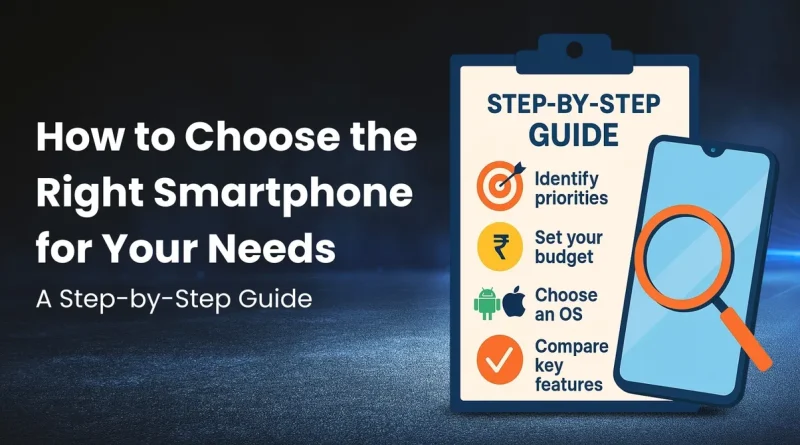
How to Choose the Right Smartphone in 2026: A Practical Buying Guide
Buying a smartphone in 2026 is genuinely more complicated than it used to be.
Not because the phones are worse. They are considerably better across the board. The problem is that there are more options than ever, more marketing noise, more confusing spec comparisons, and a price range that goes from almost nothing to over a thousand dollars.
Most buying guides make it worse by comparing specifications nobody outside of a hardware review lab actually understands. This guide does something different. It focuses on what actually matters when choosing a phone for the way you realistically live your life.
The First Question to Answer: What Do You Actually Use a Phone For?
Before looking at any specific phones, spend two minutes honestly thinking about how you use your current device. This single exercise will eliminate half the options immediately and save you a lot of time and money.
Most people’s smartphone use breaks down into a small number of core activities: communication (calls, messages, email), social media and content consumption, photography, navigation, and occasionally work-related tasks.
Very few people genuinely need the absolute best performance in all of these categories simultaneously. Matching your actual usage to the right phone tier will serve you much better than buying the most expensive option available just in case.
Ask yourself:
Do you care deeply about camera quality or is good-enough fine? Camera is often the biggest driver of price difference between phones. If you mainly photograph food and occasional holiday snaps rather than pursuing photography seriously, you do not need to spend on the very best camera system available.
How long do you keep a phone before upgrading? If you replace every two years, mid-range phones are often the better value. If you want five years of useful life from a device, spending more on flagship longevity and software support makes sense.
Do you care about gaming performance? High-performance gaming on a smartphone requires a high-end processor. If gaming is important to you it is worth spending on. If you mostly play casual games it is not.
How much storage do you realistically need? If you stream rather than download, keep photos in cloud storage, and do not install hundreds of apps, you probably need less storage than you think.
Understanding the Key Specifications
You do not need to understand every specification on a phone’s sheet. But a handful of them directly affect your day-to-day experience.
Processor (Chipset)
The processor determines how fast your phone runs, how efficiently it handles multiple tasks, and how long the device stays current in terms of software support. It also heavily influences battery life because more efficient processors use less power.
In 2026, the leading processors are Apple’s A18 Pro (iPhone), Qualcomm’s Snapdragon 8 Elite, and Google’s Tensor G5 (Pixel). For Android phones, MediaTek Dimensity chips in the mid-range have become genuinely capable for most everyday tasks.
If you are not a gamer or heavy power user, a mid-range processor will handle everything you do without any noticeable limitation.
AI is now built into the camera systems of almost every flagship phone. Our guide on top AI tools in 2026 covers how AI is changing everyday technology.
Battery Life and Charging
Battery life varies enormously between phones and is one of the most impactful specs on daily satisfaction. A phone with 30% more battery capacity than another does not necessarily last 30% longer because processor efficiency, software optimization, and screen type all affect drain rates.
The most reliable way to evaluate real-world battery life is to check independent reviews that test actual screen-on time rather than relying on manufacturer claims.
Charging speed matters too. Flagship phones now offer very fast wired charging, and wireless charging is increasingly standard even in mid-range devices. If you use wireless charging regularly, make sure the phone you choose supports it at a speed you find acceptable.
Display
Screen quality affects your experience every single time you use your phone. The main things to look at are:
Size. Phones range from around 6 to 6.9 inches currently. Larger screens are better for media consumption but less comfortable for one-handed use and do not fit as easily in pockets.
Refresh rate. 120Hz displays are noticeably smoother than 60Hz for scrolling and animation. Most mid-range and flagship phones now offer 120Hz or higher. It is a meaningful upgrade from 60Hz that you notice every day.
Brightness. Important for outdoor use. Phones with higher peak brightness are significantly easier to read in direct sunlight.
Resolution. OLED displays at 1080p are sharp enough for most people. Higher resolutions use more battery and the difference is not clearly visible at normal phone-to-eye distances.
Camera System
Camera quality is often the most personal specification because what matters depends entirely on what you photograph and how much you care about the results.
A few things worth paying attention to:
Main sensor size. Larger sensors capture more light and perform better in low-light conditions. This is one of the most meaningful differences between budget and premium cameras.
Software processing. Modern smartphone cameras rely heavily on AI processing to produce the final image. Google Pixel phones are a good example of getting excellent results from smaller sensors through exceptional software.
Zoom capability. Optical zoom (using a physical telephoto lens) produces much better results than digital zoom (cropping the main image). If you frequently zoom in for distant subjects, look for phones with dedicated telephoto lenses.
Video. If video recording matters to you, look specifically at video quality tests rather than photo reviews since the two do not always correlate.
Storage and RAM
32GB of storage is now genuinely insufficient for most people. 128GB is a reasonable minimum. 256GB is comfortable if you take a lot of photos or download content. 512GB is only necessary for heavy content creators.
RAM affects how many apps stay active in memory without needing to reload. 8GB of RAM is comfortable for most people. 12GB makes a noticeable difference for heavy multitaskers. 16GB is primarily relevant for gaming and professional-level multitasking.
The Main Choices: iOS vs Android
This is often the first decision and it matters more than any individual specification.
Choose iPhone if:
You are already in the Apple ecosystem and have a Mac, iPad, or Apple Watch. The integration between Apple devices is genuinely excellent and switching away from it has real costs. You prioritize long software support. Apple currently provides major iOS updates for six to seven years. You value consistency and simplicity of the software experience over customization.
Choose Android if:
You want more customization and control over how your phone works. You prefer more variety in hardware options and price points. You use Google services heavily and want the deepest integration. You prefer a larger screen or more flexibility in form factor.
Neither is objectively better. The right choice depends almost entirely on your existing ecosystem and personal preferences.
The Best Smartphones by Budget in 2026
Rather than recommending specific models that will date quickly, here is a framework by budget that reflects what each tier currently delivers.
Budget: Under $300
At this price point in 2026 you can get a phone with a solid processor, 128GB storage, a capable main camera, and decent battery life. The compromises are usually in display quality (60Hz rather than 120Hz), camera versatility (typically just one or two lenses), slower charging, and shorter software support windows.
Good choices in this range typically come from Samsung’s A-series, Google’s Pixel A-series, and various Xiaomi and Redmi models depending on your region.
If this is your budget, prioritize battery life and software update commitment over camera spec sheet numbers.
Mid-Range: $300 to $600
This is the sweet spot for most buyers in 2026. Mid-range phones in this range now offer 120Hz OLED displays, multi-camera systems with genuine telephoto capability, large batteries with fast charging, and good processing power that will stay relevant for several years.
The gap between mid-range and flagship has narrowed significantly. For most users, a well-chosen phone in this range is indistinguishable from a flagship in daily use.
Google Pixel 9a, Samsung Galaxy A55, and OnePlus 13R are examples of the kind of devices that represent strong value in this range.
Flagship: $700 and above
Flagship phones in 2026 offer the best cameras available in any mobile device, the fastest processors, the brightest and highest resolution displays, the most durable build quality, and the longest software support.
They are worth the premium if you are a serious mobile photographer, push your phone’s performance limits regularly, or want to keep a device for five or more years.
Apple iPhone 16 Pro, Samsung Galaxy S25 Ultra, and Google Pixel 9 Pro are the standard-setters in this range.
If budget is a concern, our guide on how to save money every month covers practical ways to set aside money for larger purchases like a new phone.
Things to Think About Beyond the Spec Sheet
Software support lifetime. This is underrated in most buying decisions. A phone that receives major software updates for five years is significantly better long-term value than one supported for two. Apple leads here, currently committing to seven years. Google now promises seven years for Pixel phones. Samsung has extended to seven years for flagship Galaxy devices.
Repairability. Right to repair legislation is changing the landscape but ease and cost of repair still varies enormously between brands and models. iFixit scores and the availability of third-party repair parts are worth checking if you are concerned about long-term costs.
Case and accessory ecosystem. If you care about having a wide selection of cases, chargers, and accessories, more popular models have substantially bigger ecosystems. This matters most for iPhones and flagship Samsung models.
Resale value. iPhones retain value better than almost any other smartphone. If you upgrade regularly and sell your old device, this materially affects the true cost of ownership.
A Simple Decision Framework
If you are still unsure after reading through the considerations above, here is a simple three-question framework.
What is my honest budget? Choose a budget you are genuinely comfortable with, not the maximum you could theoretically spend.
What matters most to me? Camera, battery life, screen quality, software longevity, ecosystem integration. Pick your top two or three priorities.
What do the independent reviewers say? Check GSMArena, The Verge, and YouTube reviewers for real-world tests of the specific phones on your shortlist. Manufacturer specifications are marketing. Independent tests are reality.
Frequently Asked Questions
How often should I replace my smartphone?
For most people, three to four years is a sensible replacement cycle if you choose a phone with good software support. Replacing annually rarely makes financial or practical sense unless you sell your old phone at good value.
Is the most expensive phone always the best?
No. The most expensive phones offer the best performance in demanding tasks and the best camera systems. For everyday use, mid-range phones in 2026 deliver an excellent experience for most people at significantly lower cost.
Should I buy unlocked or through a carrier?
Buying unlocked gives you more flexibility to switch carriers, often works out cheaper over the contract period, and means you get software updates directly from the manufacturer rather than waiting for carrier approval. The upfront cost is higher but the total cost is often lower.
Is 5G worth paying extra for?
5G coverage is expanding but still inconsistent in many areas. Most current mid-range and flagship phones include 5G as standard rather than a premium feature. If it is not adding significant cost, having 5G capability is worthwhile for future-proofing. If it adds meaningful cost and you are in an area without coverage, it is less important.
How much storage do I actually need?
If you use cloud services for photos and stream music and video, 128GB is sufficient for most people. If you prefer to keep everything locally, download music and podcasts for offline use, and take a lot of video, 256GB is more comfortable.
Final Thoughts
The right smartphone is the one that matches how you actually use a phone, fits your budget comfortably, and will serve you well for the years you plan to keep it.
The best phone in the world is not the most expensive one. It is the one that does what you need without making you feel like you are missing out on the things that actually matter to you.
Start with your budget and your two or three most important priorities. Let those filter the options. Then check real-world reviews of the shortlisted phones. You will land on the right choice faster and with more confidence than any spec comparison will give you.
Specific phone models and prices change frequently. Always verify current availability and pricing before making a purchase decision.