
Scientists Just Unlocked an Endless Supply of Cancer-Fighting Cells: What It Means for You
Cancer treatment just took a genuinely significant step forward. Scientists at the University of Southern California have discovered a way to create a potentially renewable supply of genetically engineered immune cells that can attack cancer and strengthen the body’s natural defenses. sciencedaily
This is not a vague promise about treatments that might arrive in twenty years. It is a concrete scientific breakthrough that addresses one of the most frustrating limitations of modern cancer immunotherapy — the fact that the most powerful treatments we currently have are extremely difficult and expensive to produce at scale.
Furthermore, the implications go well beyond cancer. The same approach could eventually be applied to autoimmune diseases, infections, and other conditions where a stronger, more targeted immune response would help. This article explains what the scientists discovered, why it matters, and what it could mean for cancer patients in the years ahead.
The Problem This Discovery Is Solving
To understand why this breakthrough matters, you first need to understand the problem it is solving.
One of the most powerful cancer treatments ever invented has a supply problem: it has to be built, one batch at a time, from each patient’s own cells. jerrycards
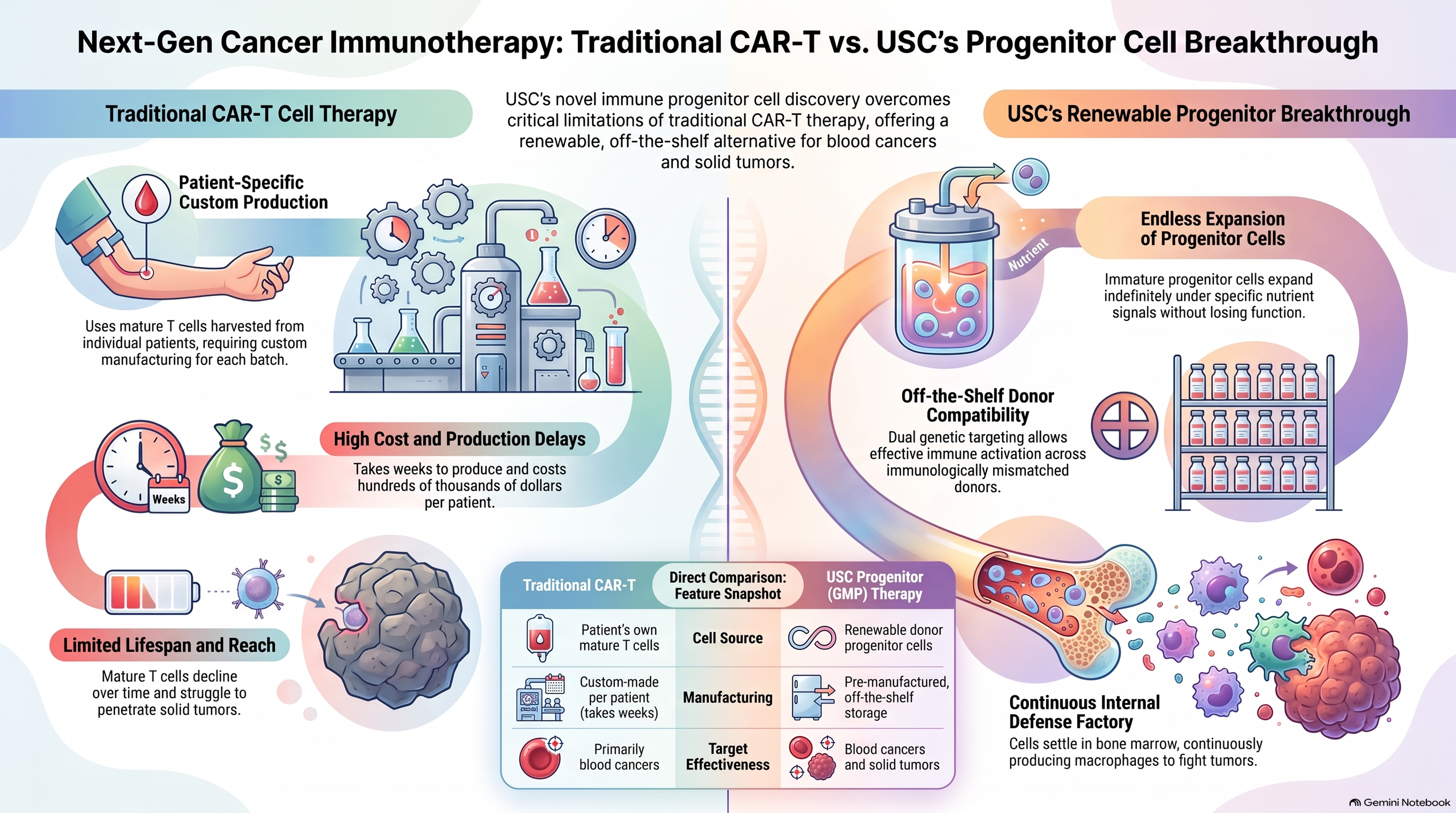
The treatment being referred to is called CAR-T cell therapy. CAR stands for chimeric antigen receptor. The process works by taking T cells from a patient’s own blood, genetically engineering them in a laboratory to recognize and attack cancer cells, growing them in large numbers, and then infusing them back into the patient.
When it works, CAR-T therapy can produce remarkable results — complete remissions in patients who had exhausted every other option. However, the production process is extraordinarily complex, time-consuming, and expensive. Each treatment must be custom-made for each individual patient. Furthermore, the process can take weeks at a time when cancer patients do not always have weeks to spare. And the cost can run to hundreds of thousands of dollars per patient.
The USC discovery offers a potential way around all of these limitations.
What the USC Scientists Actually Did
Scientists have developed a new way to grow and endlessly expand the immune-cell precursors that produce macrophages, opening the door to a powerful new generation of cancer immunotherapies. sciencedaily
The key word here is precursors. Instead of engineering mature immune cells — the approach used in current CAR-T therapy — the USC team went further back in the developmental process to work with immature cells called granulocyte-macrophage progenitors, or GMPs.
Scientists at the University of Southern California have discovered a way to genetically engineer macrophage progenitor cells, potentially revolutionizing cancer immunotherapy. These engineered progenitor cells have shown promise in generating potent macrophages that can effectively combat both blood cancer and solid tumors in mice. yahoo
Macrophages are a type of immune cell that plays multiple roles in fighting disease. They are among the immune system’s most versatile defenders — capable of directly consuming pathogens and cancer cells, calling for backup from other immune cells, and coordinating broader immune responses. However, they are a wonderful target for cancer research, but so far, next-generation therapies have largely failed to unlock their true potential. yahoo
The USC team found a way to change that.
The Surprising Discovery About Progenitor Cells
The most scientifically exciting aspect of this research is what the team discovered about the progenitor cells themselves.
Scientists generally have not considered progenitor cells to possess long-term self-renewal capability. In other words, the scientific assumption was that these immature cells could only divide a limited number of times before either maturing into adult immune cells or dying. They were not considered to be renewable in the way that true stem cells are. sciencedaily
The USC team found this assumption was wrong — at least under the right conditions.
Using mouse and human GMPs, the researchers figured out exactly what these cells need to eat to grow, feeding them a complex mix of chemicals at very specific stages. By providing the right nutrients and signals at precisely the right moments, the team was able to keep the progenitor cells in their immature state — preventing them from maturing prematurely — while allowing them to multiply extensively. yahoo
Furthermore, even after extended growth, the cells preserved their molecular and cellular characteristics and continued to generate functional macrophages and other immune cells. This is critical. It means the cells did not lose their identity or their function even after repeated division — they remained capable of producing effective immune defenders when needed. kpnews
How the Engineering Works
Simply growing large numbers of progenitor cells would be useful but not sufficient for cancer treatment. The USC team went further by genetically engineering the cells with two additional capabilities.
The researchers equipped GMPs with a chimeric antigen receptor, or CAR, enabling the cells to recognize a specific marker found on cancer cells. The team also added a second signal designed to activate nearby immune cells that help stimulate tumor-fighting T cells and strengthen the body’s natural defenses. jerrycards
The CAR component is borrowed from the existing CAR-T cell therapy approach — it is a synthetic receptor that tells the immune cell exactly what to look for and attack. What makes the USC approach different is that this targeting capability is now built into a renewable progenitor cell rather than a mature T cell.
The second modification — the immune-activating signal — is particularly clever. Rather than simply creating engineered cells that attack cancer directly, the researchers designed the cells to also recruit other parts of the immune system to join the fight. Importantly, this additional signal remains effective even when donor and recipient cells are immunologically mismatched. kpnews
That last point is enormously significant. One of the major barriers to off-the-shelf cell therapies is immunological compatibility — the body’s tendency to reject cells from another person. If the immune-activating signal works even across mismatched donors and recipients, it opens the door to treatments that could be manufactured in advance and stored until needed, rather than custom-made for each individual patient.
What Happened When They Tested It in Mice
In mice, the engineered cells slowed blood cancers and solid tumors — pointing toward renewable, off-the-shelf cancer cell therapy. jerrycards
The results across different cancer types were encouraging. The CAR-engineered GMPs slowed disease progression in blood cancer models, and cells equipped with both the CAR and the immune-activating signal performed better still. Solid tumors — historically harder to treat with immunotherapy than blood cancers — also showed responses.
The cells successfully settled into the bone marrow and other blood-forming tissues, where they continuously generated engineered macrophages and additional immune cells. This is remarkable behaviour. Instead of simply delivering a one-time dose of engineered cells, the approach appears to create a sustained internal production system — a living factory that keeps producing cancer-fighting cells from within the body. kpnews
Why This Is Different From Existing Immunotherapy
Current cancer immunotherapies, including CAR-T therapy, have produced extraordinary results for some patients. However, they have significant limitations beyond the production challenges.
Mature T cells, which form the basis of CAR-T therapy, have a limited lifespan. Once infused, they fight the cancer for a period and then gradually decline. Patients sometimes see excellent initial responses followed by relapse months later when the engineered T cells have exhausted themselves.
The GMP-based approach could address this limitation directly. Because the progenitor cells can self-renew and continuously produce new macrophages, the therapy could potentially sustain itself over much longer periods than current T cell therapies.
Additionally, macrophages work differently from T cells in ways that could be therapeutically valuable. The research suggests that targeting the progenitors of immune cells may be a more effective approach for future immunotherapies than re-engineering mature T cells. Macrophages can penetrate deep into solid tumors — a place where T cells often struggle to reach — and they can orchestrate broader immune responses rather than acting alone. yahoo
What This Means for Future Cancer Treatment
The honest framing here is that this is a very promising early-stage discovery, not an approved treatment. The results so far are in mice, and the path from mouse studies to approved human therapies is long, expensive, and not guaranteed.
However, the significance of what the USC team has demonstrated should not be understated. They have shown that:
Progenitor immune cells can be expanded indefinitely under the right conditions, overturning a previous scientific assumption about their limitations.
These expanded cells can be genetically engineered with targeting and immune-activating capabilities while maintaining their function.
The engineered cells work in living organisms to slow cancer progression.
The immune-activating signal functions across mismatched donors and recipients, pointing toward off-the-shelf manufacturing.
The hope is that this endless supply of GMPs can now be used for future cancer immunotherapies. Furthermore, one of the researchers noted: “We have already demonstrated engineering of these cells to drive multiple potent functions, and there is a lot more to be explored.” sciencedailyyahoo
Clinical trials in humans would be the next major step. If the approach works safely and effectively in humans as it does in mice, it could eventually lead to treatments that are manufactured in advance, stored like blood products, and made available to patients at a fraction of the current cost and timeline of personalised CAR-T therapies.
The Broader Significance for Medicine
While the cancer treatment applications are the most immediately exciting, the implications of this discovery extend further.
A renewable supply of genetically engineerable immune cell progenitors has potential applications in any condition where modifying immune function could be beneficial. Autoimmune diseases, where the immune system attacks the body’s own tissues, could potentially be addressed by engineering cells to suppress specific harmful immune responses. Infections caused by pathogens that evade normal immune responses could be targeted with specifically engineered cells.
Additionally, the ability to create off-the-shelf immune cell therapies rather than patient-specific ones would dramatically change the economics of advanced immunotherapy. Currently these treatments are accessible only in wealthy countries with sophisticated medical infrastructure. A manufacturable, storable immune cell product could eventually be distributed far more widely.
This connects to a broader pattern in medical research where advances in genetic engineering and cell biology are opening genuinely new categories of treatment rather than simply improving existing approaches. For understanding how technology is more broadly changing healthcare and health outcomes, our guide on easy daily habits for a healthier lifestyle covers the practical health foundations that matter for everyone right now, while our guide on how to boost your immune system with the right foods covers the nutrition science that supports immune health in everyday life.
Frequently Asked Questions
What did the USC scientists discover?
USC scientists discovered a way to create a potentially renewable supply of genetically engineered immune cells that can attack cancer and strengthen the body’s natural defenses. By growing and modifying immature immune cells rather than mature ones, researchers developed a system that can continuously produce tumor-fighting cells inside the body. sciencedaily
What are GMP cells?
GMP stands for granulocyte-macrophage progenitor cells. These are immature immune cells that normally develop into macrophages and other immune cells. The USC team discovered that under the right conditions, these cells can be maintained in their immature state and expanded indefinitely, then engineered with cancer-targeting capabilities.
How is this different from current CAR-T therapy?
Current CAR-T therapy uses mature T cells taken from each individual patient, engineered in a lab, and returned to that same patient. The USC approach uses progenitor cells that can potentially be manufactured in advance, stored, and used for multiple patients — like a blood product rather than a custom treatment.
Has this been tested in humans?
Not yet. The research so far has been conducted in mice. Clinical trials in humans would be the necessary next step before this approach could become an approved treatment. That process typically takes several years.
When could this treatment be available?
It is too early to give a specific timeline. The research must first be replicated by other teams, then safety and efficacy must be established in human clinical trials, then regulatory approval processes must be completed. A realistic timeframe for potential clinical availability would be several years at minimum.
What types of cancer could this treat?
The USC research showed results in both blood cancers and solid tumors in mice. Blood cancers — including certain leukemias and lymphomas — have historically responded well to immunotherapy. Solid tumors have been harder to treat, making the positive results in that category particularly significant.
Could this help with diseases other than cancer?
Potentially yes. A renewable supply of engineerable immune cells has theoretical applications in autoimmune diseases, infections, and other conditions where modifying immune function could be beneficial. However, cancer is the primary focus of current research.
This article is based on research published by the Keck School of Medicine of USC in October 2026. Visit ScienceDaily and the Keck School of Medicine of USC for the full research details. This article is for general informational purposes only and does not constitute medical advice.
